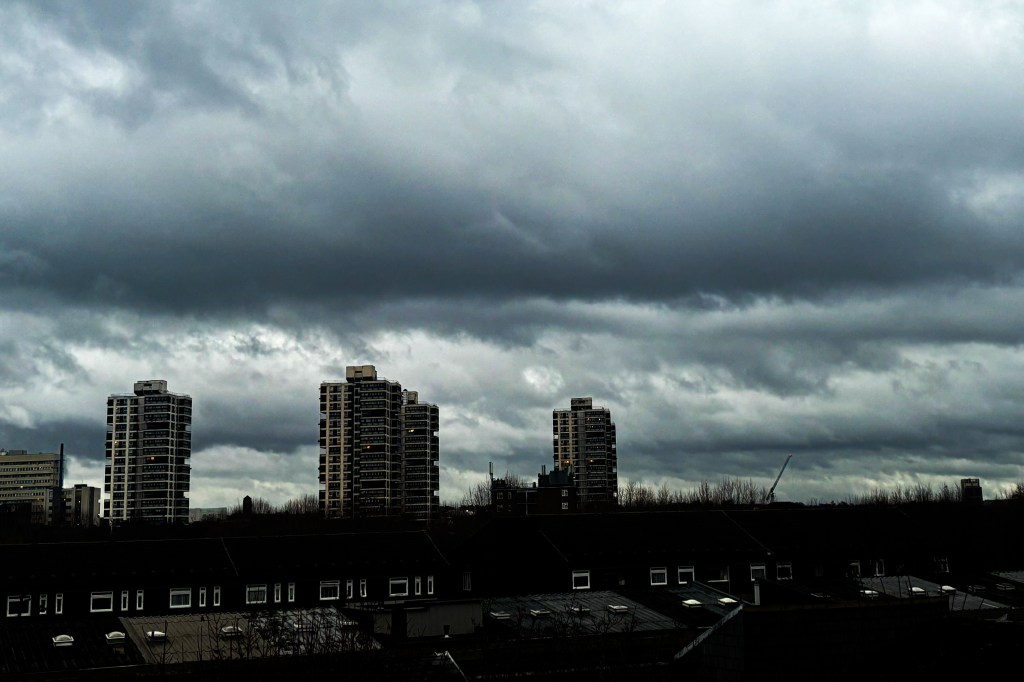
Presence, 5 December 2024, © 2024 Bobby Crosby
My friend Edward Unwin recently sent me a copy of Roadside Picnic by Boris and Arkady Strugatsky, two brothers who wrote some of the best-known Soviet science fiction outside of Russia from the late 1950s through to the 1980s. Famously, the novel inspired the 1979 film Stalker, and a few decades later the Ukrainian video game series of the same name, a new installation of which was released last month.
Both his tenacious efforts to get me reading more sci-fi (a genre I’ve never given much time to) and the excellence of the book itself were deserving of a full review, so I wrote the below, which in turn finally got me to starting this blog. So, thanks Ed.
The organising principle of Roadside Picnic is, of course, the difference between understanding and knowing. What the structure of the book implies is inescapable, it is bookended by the inability both of humanity to know the reasons behind the aliens’ short visitation and of protagonist Redrick Schuhart to really know his role in the world that comes after it. It begins with a technical description of the Visit – some of the how and none of the why – and concludes with Red unable to explain his own justifications for his actions.
On one level, I see in the novel an exploration of geographical determinism. Much like our own history is, inevitably, the product of a series of astronomical and biochemical flukes, such is also true of the world of Roadside Picnic. Agriculture and metalworking and conquest and disease all enter from earth and rock, just as the philosophical consequences of the Visit enter onto humanity, and its economic consequences on those reliant on the Zone. In my eyes, there are very few explicit value statements in the novel, few expressions of political valence. In its place are the consequences of materialism. It rejects teleology out of hand.
In the dialogue between Dr Valentine Pillman and Dick Noonan three-quarters of the way through the book, which acts as a narrative tentpole of sorts, we learn about Pillman’s eponymous theory of the Visit. He argues that the beings that visit and depart leaving behind unknowable technology and unearthly forces are on a higher plane of sentience, simply too advanced to be understood by humans – like an insect would feel examining the aftermath of a drunken night by a campfire, or an abandoned picnic on the side of the road.
In place of knowledge, historical inertia takes over. The world keeps turning and profiteers spring up on the frontiers of the six zones. Enter the protagonist.
First off, Red is no hero. He hits a 20-year-old girl unprovoked, and later sleeps with her despite having a wife and daughter. He is prone to bouts of alcohol-induced violence, and it is implied this is behaviour maintained since adolescence. A half-century-old book this may be, with all the associated retrospectivity, Red is written to be a man guided more by ennui than any moral compass.
His actions are essentially hedonistic. Adrenaline and cash from illicit visits to the Zone, extramarital affairs, fried sausages, vodka shots, and Lucky Strikes. He is a creature of pretty deviant habit at best, written like an addict at worst. Chapter titles track his age and each expedition is meant to be the last. This is immediately established – the first paycheck we see is spent on alcohol and cigarettes – and maintained throughout.
He eventually tricks his mistress’s brother and the son of someone who was essentially a colleague (however despised) into walking towards his own death for personal gain. He knowingly sacrifices Arthur without really believing what he truly wants out of it, who pages earlier Red describes as having the qualities of a future president.
Red is almost nihilistically immoral, then. But this is a red herring. The book’s judgment is clear in the denouement (“Look into my soul, I know – everything you need is there…I’ve never sold my soul to anyone! It’s mine, it’s human!”. To say he is inherently bad might be well evidenced, but it misses the point. Like all things, he is corrupted by his circumstances.
I think Red is simply doing what he has always done. The world keeps turning. In the opening paragraphs of the final chapter, he states as much: he doesn’t need the money, he has his house and his wife and his garden. And the money wouldn’t cure his mutant daughter, because his fatal flaw was committed when he stepped foot in the Zone for the first time and sealed the fate of his future family.
This is not the story of one avaricious man. Red is depicted throughout as being from a disadvantaged background, a working-class orphan. He is not some unscrupulous profit maximiser like Burbridge, rather a kind of self-employed skilled labourer. Survive and scrape some pleasure out of life while you can, and ideally without having to sacrifice any of your self-pleasuring potential to an exploitative employer. No judgement there.
Perhaps his sacrifice of Arthur reveals to Red the extent of his greed, pulling aside the curtain and revealing how the centrality of the Zone to his bleak existence has corrupted him. Not quickly and violently, like the Zone’s bug traps or meat grinders. But glacially, imperceptibly, like a frog in boiling water. I’m not so sure.
Is his mania that breaks out when he encounters the Golden Sphere the panic of a hollow existence finally unable to be ignored, making the book a lamentation of the banality, the arbitrariness, of the human condition? Or is there something more fundamental at play? Is the world of Roadside Picnic flat, ahistorical, stagnant? Or is it hierarchical, progressive, even dialectical? It would excuse the lack of agency that the characters seem to have, material forces binding them to the outskirts of the Zone like a fly in tape.
The all-but-setting of the story in English-speaking North America might offer a clue. I expect the debate around the decision to base the story in the West is a key to understanding the novel, if one of many. Without getting around apparatchik censorship the novel would not have been published, and the fact that Boris Strugatsky even dedicates a 2012 afterword to describing the necessary redrafting process shows this was at the front of their minds.
Bluntly, did they set it in the West because it makes it easier to claim to the censors that the book isn’t criticising their own authoritarian government, especially for such a bleak story with a bleak ending? Or is this actually a criticism of a morally vacuous, selfish West? After his conversation with General Lemchen, Dick Noonan considers the fact that in Russia, there are no stalkers, there is no black-market trade of alien debris: “they really have an empty belt around around the Zone – a hundred miles wide, no one around, none of these stinking tourists, and no Burbidges.”
Perhaps, then, the premier science fiction novel from the USSR really is anti-capitalist. That might be a bit on the nose, but considering the previous point on their long fight against the Komsomol, it is an idea worth entertaining and people are allowed to be ambiguous in any event. This was not really a time nor a culture that loved subtlety. And you can be critical of an overbearing state stifling creative freedom, while also disagreeing with an economic ideology which does not appear to be moving our own civilisation to that ‘higher plane’ the world of Roadside Picnic would need to interpret and exploit the left-behind artifacts as they were intended. This would be especially so if you grew up in a country that preaches all the ills of individualism and less of the virtues.
Without a plan or a design, or even a destination, are we left to scrabble around in the dirt, accumulating wealth but forever lacking the ability to know what makes it worthwhile, or indeed how to use it to ennoble humankind? I think so, but the Strugatsky brothers make clear that they do not really have the answer to the questions they pose. The gap remains unbridgeable.
This is one of the conclusions that Dr Pillman flirts with in the titular scene which represents the real apogee of Roadside Picnic. What separates animal from man and man from extraterrestrial is that the higher being thinks it is being purposeful, he says. We tell ourselves that cars and picnics have purposes. But the cosmic debris left behind on that lay-by of a planet tells us that maybe it is vain of us to assume so. Perhaps it is just as presumptuous to claim that the visitors knew where they were going too.
Bobby Crosby
3.12.24
 bobby crosby
Leave a comment