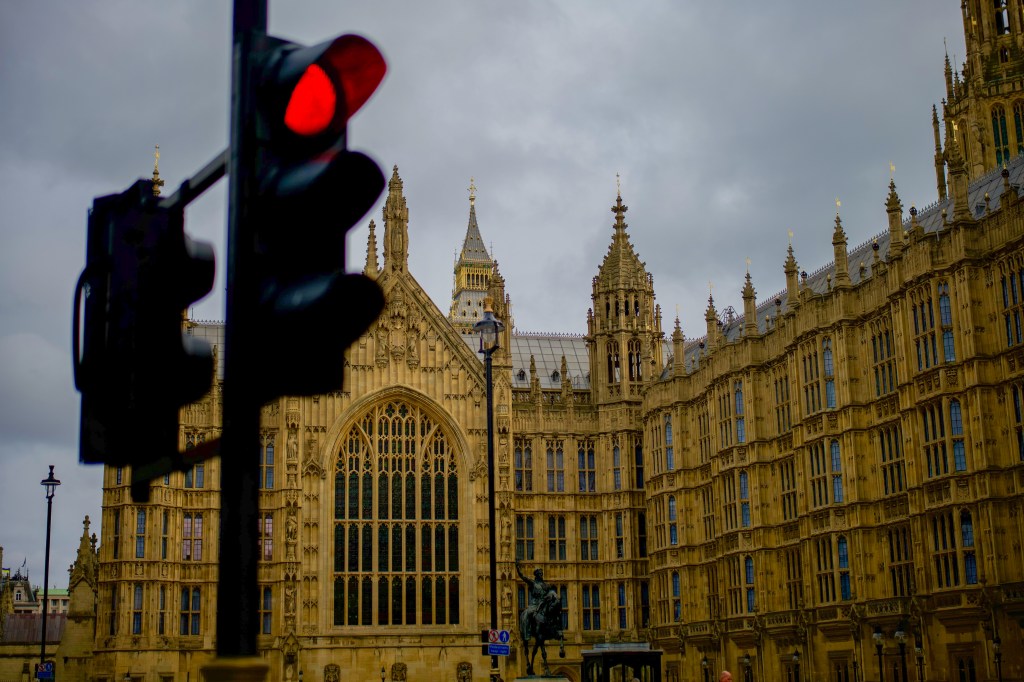
Do Not Pass Go, 17 March 2025, © 2025 Bobby Crosby
Repeated government briefings last week about considerable cuts to disability benefits, with the lion’s share of savings coming from slashing Personal Independence Payments (PIP), have rightly sparked a wave of discontent within the Labour Party.
With a prime minister praising Thatcherite deregulation, reducing the size of the civil service, axing the winter fuel allowance, retreating from international development, and jacking up defence spending, many are asking whether this is the most right-wing Labour government in modern British history. Many are asking whether it is even further to the right of the Conservatives.
This is a worthwhile question – and not just because of what it tells us about British politics in 2025. It is worthwhile because of what it tells us about Britain’s relationship to the emerging world order, as the transatlantic alliance fractures and the influence of a small island nation – agonisingly close but now separate to the world’s largest trading bloc – continues to wane.
“No return to austerity”
Some Labour members have been claiming online that news of major cuts appearing in the press were the product of maladroit leaks or even outright invention. This was at best naïve and at worst malicious. The health secretary then ominously chimed in on Sunday with Laura Kuenssberg, saying “the moral of the story is, don’t rely on briefing and speculation” while defending the principle of incoming cuts.
Months and months of media appearances by Liz Kendall have offered ample warning to the government’s intentions. Two days before it was reported that 1 million Britons could lose disability benefits, the Keir Starmer gave another deregulationist speech, promising a smaller state. This is not coming out of left field.
If reports of the Speaker unsuccessfully warning Starmer not to announce policy directly to the press are to be believed too, you are in denial if you think the government is not trying to get away with slashing even more welfare spending than Osborne.
Clearly, most Labour MPs have taken this at face value, and many are rightly expressing discontent. Whether the government backs down, suffers a rebellion, or forces through its brutal austerity measures, this episode draws attention to the well-documented problem at the heart of the Starmer project.
Power before principles
It has no moral anchor. We know this. Pursuit of power can be found where the ideological gall bladder should be. Whether you think the current occupiers of Downing Street sunk the Labour left (and then everybody else) because they saw an unelectable Corbyn as truly intolerable in his enabling of Tory vandalism, or because they were and are driven by pure self-interest, is by the by.
A precision-guided strategy and a tip-toe campaign could be described as electorally efficient. I wouldn’t disagree, but the story of the party in government points to a political agenda that is colourless at best. Starmerism *isn’t*.
The fascinating thing is how the anti-credo of power over principles has allowed the party to now drift into doing things the Tories had only ever dreamed of.
A prime minister too happy to delegate to his chancellor has given Treasury Brain a stay of execution, and in the place of an intellectually substantive agenda, inertia reigns.
Hence the growth drive (surely the default stance of any government), deregulation of planning (hardly inventive, however overdue) and culture warring through following the anti-immigration tune.
Things taken for granted, done before, or forced onto the agenda by a certain upstart party. Defence spending raised, undeniably necessary but deliberately ducked in the manifesto. 0.2% of GDP taken from rather than given to the international aid budget as promised. And so on.
The few leftish drives are either explainable within this framework or are the exceptions that prove the rule, being countable on one hand. Employer tax rises get around fiscal rules while keeping the books balanced, following the prognosis that any tax and spend talk whatsoever would electorally tar and feather the party.
Workers’ rights legislation and Bridget Phillipson are big changes in direction after strike-busting laws and Michael Gove, but the fact that this counterargument can be addressed reasonably effectively within three sentences is telling.
Rudderless and rightwards
Two forces, then, one historic and one contemporary. The rightwards drift of Labour, viewed through the lens of party factionalism, must be seen as a reaction to 2015-2019. Starmer, so the story goes, treads the path of Blair and Kinnock before him in clobbering the left to consolidate power and demonstrate electability.
For those who derided Labour’s 2024 campaign for being overcautious, timid, or plain right wing, I think is to underestimate how deeply psychologically scarring losing four elections in a row is for an organisation created to win elections.
The party overcorrects: it is pushed rightwards by the left and whenever trouble arises it remembers that the strategy has worked very well so far. Then comes the second Trump presidency and the rise of Reform. Labour is then pulled rightwards by the right too.
The United States has long made the global political weather through its cultural and economic weight. This is especially true in Britain, with a common language, deep historical ties, a close trading relationship, and decades of lockstep military and intelligence cooperation. The internet and globalisation respectively accelerated these avenues of American influence.
The UK has always been especially permeable, but all of Europe, no matter any individual historic relationship to the US, has to live with the downstream consequences of decisions made in Washington.
Leave out the red meat of Labour’s legislative agenda – because Starmer hardly talks about it. His speeches since launching the Plan for Change in December have been almost entirely centred around a push for deregulation. Ousting an overcautious CMA chair, culling civil service numbers, and now cutting welfare: DOGEism with British characteristics. These comparisons are not without merit. Following the lead of the Americans but toning it down a notch makes it all the more British.
Nor is it a stretch to see Starmer deliberately finding some political refuge in Unrestrained Trumpism, as a shelter from this new uncertain world Trump himself helped unleash. That is doubly true as Reform – quite directly shaped by the American right – increasingly eats away at working class votes by capitalising on distrust and exploiting anxieties.
Starmerism is that most permeable of political entities. It will be blown by the prevailing winds. You could call this adapting to the times, but I think people would still view his premiership as characterised by either agile pragmatism or cravenness, depending on how sympathetic you would like to be, even if it did not take place within one of the few great historical turning points of the last 80 years.
“The old world is dying, and the new world struggles to be born; now is the time of monsters.”
The problem now with doing whatever is in vogue on the other side of the Atlantic is that a) the transatlantic alliance is dead anyway and b) what is currently in vogue is completely antithetical to British values – in fact, to European values. This was clear well before the American abandonment of Palestinian statehood under both Trump and Biden, and of Ukraine under Trump.
The strong doing what they will and the weak suffering what they must has caused endemic suffering over the course of human history and, most saliently for these purposes, in Europe during the first half of the 20th century. That ironically created both the conditions for European unity and the continent’s gradual withering under American security guarantees.
The Labour Party – that creator of the welfare state, that builder of social housing, that champion of economic redistribution, that founding member of NATO, is in power again during the birth of a new world. If it is not guided by uncompromisable principles, by common British values: democracy, pluralism, compassion and fairness at home and strength abroad, then it, the country, and liberal democracy may be lost. Copying the Americans is so last century.
 bobby crosby
Leave a comment