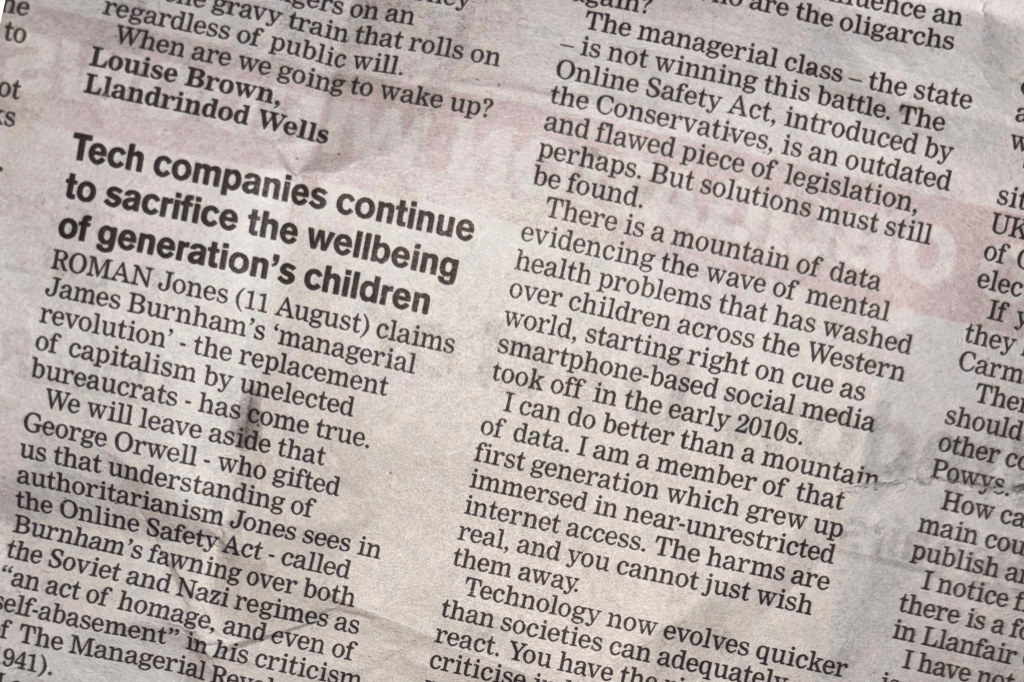
On reading a letter published in the Powys County Times (the local paper for the county I grew up in) I was so incensed by a fellow reader’s attack on attempts to regulate social media in the UK that I wrote a riposte, which was published a few weeks later. The website headline chosen by the editor amusingly summarises the opposite of the article’s argument.
Roman Jones (11 August) claims James Burnham’s ‘managerial revolution’ – the replacement of capitalism by unelected bureaucrats – has come true.
We will leave aside that George Orwell – who gifted us that understanding of authoritarianism Jones sees in the Online Safety Act – called Burnham’s fawning over both the Soviet and Nazi regimes as “an act of homage, and even of self-abasement” in his criticism of The Managerial Revolution (1941).
I am with Orwell on this one, although I am sure Jones’s evocation of Burnham’s supposed distrust of statism was intended more as a hook for his letter.
Let us instead talk directly about how unfettered access to the internet has harmed a generation of children.
I am in total agreement that scientific progress has been the result of challenging orthodoxy and allowing the open competition of ideas.
I understand, too, how the internet’s democratisation of information can be seen as the extension of these ideals.
When Orwell, though, warned of “the ever-increasing concentration of industrial and financial power”, he too saw the shift toward oligarchy coming.
Now to 2025, where six American tech companies have a market capitalisation of $18.4 trillion between them, and one man worth $413 billion can buy a platform used by some 600 million in order to influence an election. Who are the oligarchs again?
The managerial class – the state – is not winning this battle. The Online Safety Act, introduced by the Conservatives, is an outdated and flawed piece of legislation, perhaps. But solutions must still be found.
There is a mountain of data evidencing the wave of mental health problems that has washed over children across the Western world, starting right on cue as smartphone-based social media took off in the early 2010s.
I can do better than a mountain of data. I am a member of that first generation which grew up immersed in near-unrestricted internet access. The harms are real, and you cannot just wish them away.
Technology now evolves quicker than societies can adequately react. You have the right to criticise individual solutions, but we still need ones that work. That starts with correctly diagnosing the problem.
Roman Jones, like James Burnham before him, misattributes to unelected bureaucrats a very real accumulation of power and capital.
That is not where the real power lies. It is increasingly in the hands of unelected tech companies that will continue to sacrifice the wellbeing of children for profit.
 bobby crosby
Leave a comment