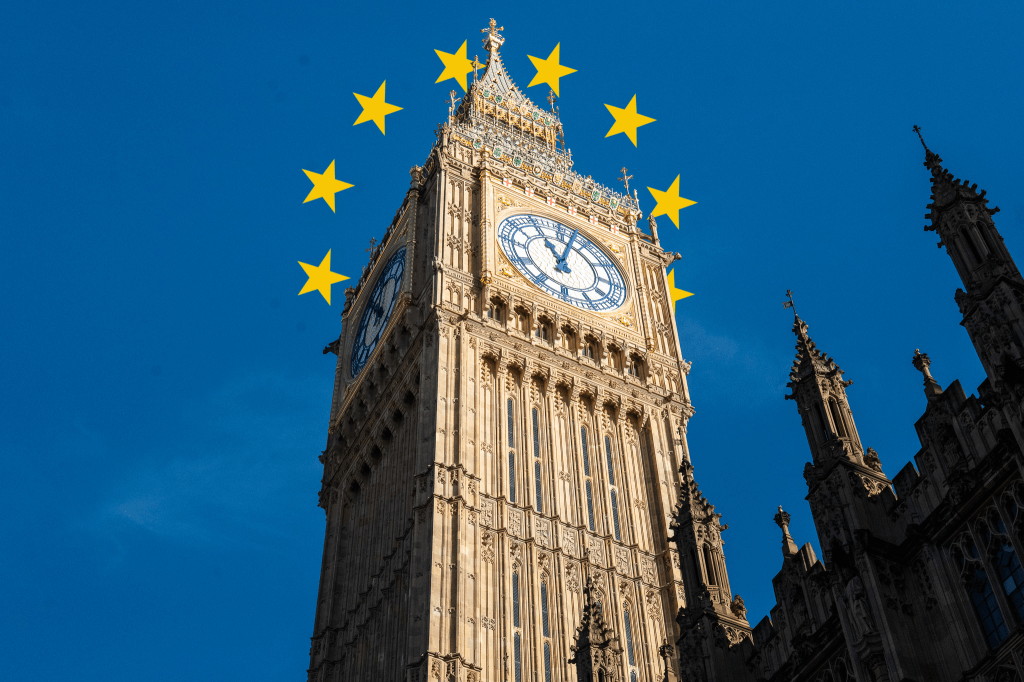
Elizabeth Tower Crowned, 28 January 2026 © 2026 Bobby Crosby
Open a world map and glance upon Britain’s place in the world. Assuming yours is a standard Mercator projection, we sit quite comfortably near the top of the middle.
A fitting metaphor for our foreign policy ten years ago. The UK enjoyed an enviable position: a seat at the European table, a pleasant ignorance of Russian revanchism, a benign relationship with China, a friendly United States.
A decade later and those foundations have crumbled one by one. We are an island adrift in the North Atlantic. There is now only one direction in which to sensibly turn: Europe.
The lapse back into realpolitik, into mercantilism, into multipolarity, is plain for all to see. The short-term impetus has been provided courtesy of the US. And there is an emerging appetite for realignment both within the Labour Party and among the electorate.
The pieces are in place for a new British foreign policy. But it will require serious political nerve to pull it off.
The writing on the wall
These are the fundamentals: the US is no longer a reliable ally and shows outward contempt towards European countries, EU members or otherwise. We are helplessly dependent on the US for arms, equipment, intelligence, industry, cloud computing, and even the maintenance of our nuclear deterrent. The Russian threat to the UK mainland – through continued hybrid warfare and the menacing of undersea infrastructure – is apparent. Our armed forces are emasculated, with near-empty coffers hamstringing rearmament.
Europe is mostly in the same bind. It too will need to reduce dependence on the United States and pursue an independent European foreign policy. The choice is clear. We can put our shoulder to the wheel of that collective endeavour, or we can wait to be forced deeper into American vassalage.
Short term incentives, long term necessity
First, the picture at home. The extent of our transatlantic dependency is proving sufficient to prevent a public break with Washington, à la Mark Carney. But at heart Sir Keir Starmer is a Europhile, as are most of his party. And as are his likeliest leadership challengers, if not Burnham then another soft-left candidate, or Streeting to the right making pro-customs union noises. Those rivals have every incentive to play the Europe card, as therefore would a counter-flanking Starmer, should he develop the guile.
With Reform approaching a year at the top of the polls, Labour will need to stop pulling its punches on the two big sticks with which to beat Farage: Trump and Brexit, both highly unpopular with the British electorate. The prize is there for the taking.
Perhaps more importantly, what really is there left for Labour to do to change the game? As things stand, the party is going down the same drain as the Conservatives and in a fraction of the time. The major advantage they have as the governing party is, in fact, to govern: fix things, win headlines, change the terrain.
The party knows it has to regain the initiative. Publicly making the case for more a substantial European realignment achieves this, whether that means seeking re-entry into the Single Market, the Customs Union, another attempt at joining Security Action for Europe, or even just going Swiss with incremental regulatory deals – but accompanied by bold rhetoric.
And, despite understandable fear about upsetting so-called Red Wall voters, Labour should be able to rely on the ‘Bregret’ phenomenon holding firm, as it has since at least 2022. Starmer’s reverse Midas touch might put a dent in that, but given his chances of survival in office are poor regardless, it is worth a punt.
Then there is the debate over voter bloc dynamics. Most recent polling has left-of-centre and right-of-centre parties taking around half the seats each. Reform has made most of its gains from the Conservatives, Labour most of its losses to parties on the left. The next General Election could well be won by the party most able to solidify its bloc. For Labour to really be worthy of the anti-Reform mantle would require a unifying policy of national importance to rally around. Again, enter Europe.
That is all before one considers the economic benefits of closer integration with our largest and nearest trading partner – and the political headaches stronger growth would assuage.
At the other end of the equation the Americans will keep giving us reasons to pivot. Distaste of Atlanticism doesn’t automatically transmute into Europhilia (nor does Bregret, for that matter) but I would expect public opinion to sour further as Trump dismantles democratic institutions while insulting our war dead.
Even if you think world police America will magically spring back into place like memory foam, Obama’s ghost running into the 2060s, you still can’t base a nation’s foreign policy on such a chasmic open question, that still has at least three years until it can begin to be answered. We’re only three weeks into 2026 and Trump has directly threatened, either militarily or economically, at least fifteen countries* by my count.
A rupture, not a transition
Pitfalls abound, to be sure. Choosing Europe would reopen domestic political wounds. A manifesto breach could further damage public trust in Labour. It would mean tearing up post-Brexit trade deals. It would mean casting our lot in with an often-divided bloc that can be slow to act, threatened from within by malignant Eurosceptic forces, not least within our own country.
The costs of realignment would be staggering, too – not just from American retaliation and the invoice from the EU, but the investment in new defence infrastructure that the British taxpayer would have to front.
The costs of inaction will always be higher, though, and the fundamental principles remain the same. We are too small to act alone, we must act in concert. We can no longer trust the United States, our foreign policy cannot rest on capriciousness. Our political and economic future is European, whether we like it or not.
There are moments in history that require pure force of will, a leap of faith irrespective of the odds. We faced such a moment in 1940, choosing to fight on and await the arrival of the New World. This time, the Old World must fend for itself.
*Venezuela, Colombia, Cuba, Canada, Mexico, Greenland, Denmark, Norway, Sweden, France, Germany, the Netherlands, Finland, Iran, and the UK.
 bobby crosby
Leave a comment