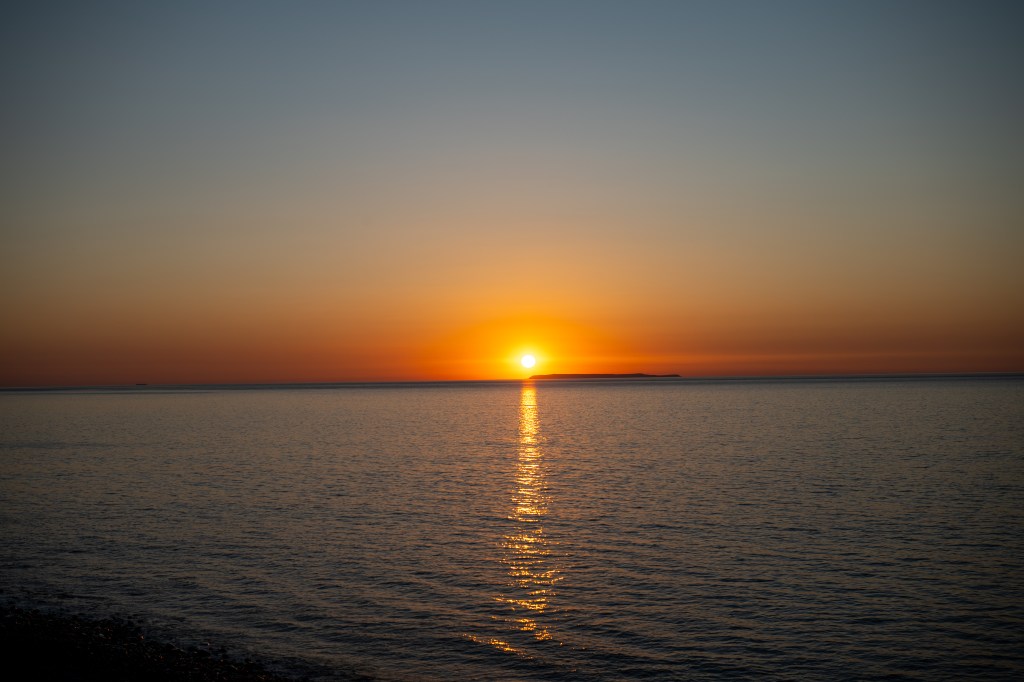
Lundy Sunset, 11 July 2025, © 2025 Bobby Crosby
At dusk in a Devonian rainforest, besieged by owls and deer and ferns, I began reading the English translation of Olga Tokarczuk’s Drive Your Plow Over the Bones of the Dead (2009). It had been indirectly recommended to me, by way of finding it on my Polish-partnered friend’s bedside table.
Tokarczuk puts some distance between things. Reading a character talk about translating William Blake (his poetry gifts us the title of the novel) into Polish – but actually back into English, from English, in my English-language copy – was separating enough.
The tree-lined Sudeten plateau, a short distance from the Czech border, separates too. The plateau acts both as a boundary between protagonist Janina Duszejko and the tamer, saner, urban interior, and as the setting for most of the eccentric contemplation that makes up the plot, interspersed with cosmically figurative murders.
And so does that contemplation, the unreliable narration coming off as simultaneously charming and disturbing, putting distance between her rich internal monologue and the orthodox world outside.
That ontological distinction between one and other, none is greater than between human and animal. The hunters lie in wait in their pulpits, levitating above the forest floor, just as the Catholic priest rises above the congregation in his own.
Tokarczuk offers a brilliant exploration of dissent, of heresy, of insanity, yes. But it is this separation between concepts, things and beings that is the real soul of the novel. Whether you want to call Duszejko’s philosophy animism or something else, it is her deadly insistence on the equality of all things that drives it forward.
A particular type of person would claim that today, growing numbers of people sympathetic to this idea can be found. They would cite it as evidence of the uprooting of a traditional ordering, a hierarchy of things. I would agree; there is no concept more orthodox than the dominion of humans over animals. There are vegans, yes, and many a carnivore claim themselves an environmentalist. But none really renounce the right to inherit the earth.
In this, I think Duszejko’s dissidence is truly revolutionary. But is it justified? Finishing the novel on a sunnier evening a few days later I slammed it down on the garden table in triumph, and on picking it up again I learned I had killed a greenfly in the process. How many decimal places would you need to measure that in human lives?
Thinking inside the box
Over the ridge in the Czech Republic 105 years prior, the philosopher Vilém Flusser was born in Prague. 71 years after that, and one year before his death, he gave an interview to a French journal, saying:
“There is no border line. There are no two phenomena in the world that could be divided by a boundary…Every systematic thinking is wrong, every system is a violation. Reality is tangled and therefore interesting. Every Cartesian thinking that creates order is fascist.”
You can forgive him for thinking so. That fascism which forced him to flee to London and then to Brazil and which took his entire family across borders and killed them in the concentration camps of Buchenwald, Theresienstadt, and Auschwitz was predicated on the separation of human beings into hierarchies.
This is where such ordered Cartesian thinking can lead. It is in the disorder, the dissolving of histories and places and suffering and ideals into each other that makes reality tangled, and therefore interesting. And so to Richard Flanagan’s Question 7 (2023).
The same night I killed the greenfly I started reading Flanagan’s memoir – what some have termed ‘auto-fiction’ – which starts with the shadow that the Second World War cast on his own family. He visits the Japanese prisoner of war camp where his Tasmanian father was held as slave labourer after being forced to work on the Burmese Death Railway. Or rather it starts with the author as a young man, spiritually if not quite physically dying in a kayaking accident on the Franklin River. Or rather it starts with H.G. Wells having an affair with Rebecca West.
Flanagan essentially writes a novel that gently follows a singular thread on an infinite corkboard of threads and pins leading up into and continuing through his own life. He then, however, throws the corkboard across the room, scattering apart each event, theme, observation, near-death experience, romantic affair, literary criticism, family memory, discussion of the ethics of nuclear bombing, and scientific revelation into fragmented paragraphs that are then carefully rearranged in a completely different order.
It is beautiful and terrifying. The way he conveys the infinite and yet claustrophobic nature of subjective experience in all that inexplicable beauty and terror is so familiar, but not familiar enough, like the space between wakefulness and sleep. And much like in Drive Your Plow Over the Bones of the Dead, the sense of would-be fantasy that comes with reading his vivid description of Tasmanian nature from a foreign eye lends that same feeling of separation.
If Olga Tokarczuk examines the interaction between human morality, the destruction of nature, and the oneness of things – what one would call monism – at the spiritual level, Richard Flanagan does the same but widens his gaze outwards, posing a much darker question in the process.
A history of violence
The Black War has been called by some scholars the most total genocide in history. I once read that a few years after the British arrived in Tasmania during the opening decades of the 19th century, soldiers and settlers formed a line of armed men, essentially shoulder to shoulder, stretching across the width of the entire island, moving north to south to either kill or surround the indigenous population. Growing hunger, resource scarcity, and sexual violence had led to a spiral of deadly attacks in the 1820s with periodic reprisals on both sides.
The ‘Black Line’ itself largely failed to achieve its aims but the effect of British colonisation nonetheless (then known to colonial administrators), was the total destruction or displacement of the indigenous Tasmanian population. Those who were not killed by frontier violence were deported to a reserve on an island off the north coast. Within a decade or so the number of survivors were in the dozens.
If the Black War can be termed a genocide, it is because, like in any settler colonial society, the colonist arrives with the intention of expropriating resources, through violence if necessary. Settlers may have fled desperate poverty or religious persecution, or arrived as convicts, but it is hard to absolve the arriviste when their ensuing actions follow the clear, cold, structural logic of conquest.
The British did not only exterminate – intentionally or otherwise – the indigenous populations of the lands they invaded. They permanently altered land itself, razing forests, introducing invasive livestock, parcelling land into property. Owing to the deep association of precolonial populations with nature and place, they permanently destroyed their existential fabric, their being-in-the-world.
To Flanagan, his own history as a Tasmanian (that is to say necessarily a living consequence of this process) is impossibly bound with the essentially British roots of ecological colonialism and the steady destruction of the natural world.
Like his thread on a corkboard, there is a line to be followed from the English conquest of their immediate neighbours, the Welsh and Irish, through British industrialisation and imperialism heralding modernity, and finally to the mass extinction of the Anthropocene. Flanagan writes of his time living in Britain:
“There was nothing. The rivers were sewers no one found unusual, the sky a haze of fine smog no one any longer saw obscuring the mid and far distance. There was a long-ago poisoned land, domesticated and dead, full of the sounds of diesel and the odour of chemicals, that people nevertheless regarded as bucolic and Edenic. Agri-business, highways, signs, industrial noise, a weeping urban sore metastasising into something that brought on only the impulse to flee.”
Towards the oneness of things
If Tokarczuk’s animist retribution is at least an idea to be entertained, and if Flanagan’s weighing of colonial genocide, environmental destruction, and the permanent fracturing of people from place in modernity are all threads on the same corkboard, then where does that leave us?
The logic goes like this. We set sail with the goal of extracting resources from a foreign place. We demark two categories, the civilised settler and the savage subaltern. No matter how peacefully we intend to act when we get there, the die is cast. I would argue, if we are informed of the consequences and do not attempt to change course, that satisfies intention on a societal scale, if not an individual one.
From this perspective Raphael Lemkin, who coined the word genocide during the Second World War and lost dozens of family members to the Holocaust, called the extermination of the indigenous Tasmanian population one of the clearest examples of genocide in human history.
What happens when we create two categories, humankind and nature, and then invent the tools to destroy the latter? What happens when we claim dominion over the natural world, mercilessly exploit it for gain to the point of mass extinction, and then repeat that on a planetary scale? Does our species become inherently genocidal?
What legitimises the deliberate killing of another living thing? Are the hunters in Drive Your Plow Over the Bones of the Dead justified in killing for sport? Is Duszejko justified in killing them back? Were the British settlers justified in exterminating a population that was, perhaps understandably, attempting to fight back?
Was Thomas Ferebee justified when he dropped an atomic bomb on Hiroshima killing 90 or 120 or 160 thousand people, but saving the life of a father, and perhaps millions of other lives in the process? Flanagan was writing before the Hamas attacks of October 7, 2023. He might ask: was Israel right to kill 60,000 Palestinians after Palestinians killed 1,139 Israelis?
Nobody can answer that. But it is in attempting to come to terms with this endless sea of chaos and suffering where Tokarczuk and Flanagan excel.
The issue they explore, as did Flusser, as did Descartes, as did many scores of other writers, thinkers and philosophers I have neither the time nor knowledge to recount here, is categorisation. It is the difference between subject and object. It is that separation of phenomena into ontologically distinct boxes.
There is a use for this. Without definition by negation, we would have no language, no shared meaning, no practical guide to the world. We would have no dialectics; and so we would have no progress. Categorisation can be a means to an end, but it can never be the end itself. That leads us down a dark road. It leads us inevitably to war, conquest, and genocide. It will lead us to ecological breakdown and the irreversible scarring of the world and thus ourselves.
We do not have to understand, categorise, and order every facet of life. We just have to accept that we are part of it, and it is part of us.


Leave a Reply