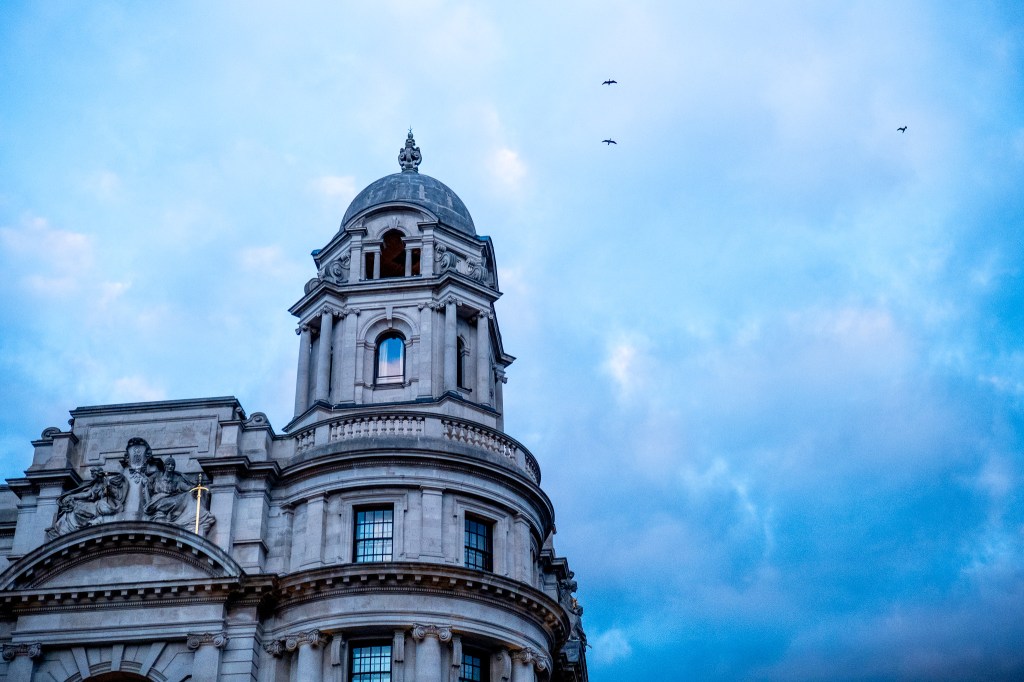
War Office, 4 February 2026, © 2026 Bobby Crosby
This year will mark the 35th anniversary since the death of the Prague-born philosopher and media theorist Vilém Flusser, whom I quoted in a previous essay last summer.
It is perhaps cliché today to dig up pre-internet media theorists and watch them seemingly predict Instagram (as pleased as they might have been) but it is an enjoyable pastime no less.
Flusser was one of the best to ever do it, writing prophecies from as early as the 1970s. His vision of the “telematic society” – a world of sufficient technological connectivity in which all individuals are lost in a sea of image-based intersubjectivity, creating a future where communication itself, rather the individual, is the organising principle of society – already strongly resembles our own.
For Flusser, this was utopian, and possibly naively so, although let us not pretend that the technoptimist isn’t still very much in vogue – just look at US equity markets. And he took the time to sketch out some communicative dystopias, too. Take his top-down propagandic pyramid, or his amphitheatre, where messages can be broadcast to the audience, who can’t interact with each other, likely a reflection of the atomised totalitarianism that triggered his flight from Prague and which would murder his family.
For me though, Flusser’s most enduring contribution is the definition of human communication: as negatively entropic. It is both an act of creation and the total sum of all information available to us. Through culture, stored knowledge about the universe and our place within it increases with every passing generation (when the arc of history is viewed from the greatest possible height – Mycenaean Greeks look away).
This is discourse. Call it dialectical if you will, he refers to the cultural prioritisation, categorisation, and storage of information. Then add to this his “ladder of abstraction” from 1985’s Into the Universe of Technical Images (translated into English from German in 2011), an idea that as civilisation progresses, we shift further into unreality. First cave paintings, then sculpture, language, the written word, photography and finally into AI-generated video and unseen algorithms driving everything from autonomous cars to financial markets to dating.
Predictably, given the name ‘negatively entropic’, you end up with something that defies that one true rule of the universe: entropy. Everything that will ever be is getting colder and further away and will, eventually, die. We are the only species on earth that is able to meaningfully advance its sum total – through language and culture – by changing neither our physicality nor our number. We have long escaped biological evolution.
And so finally, what does that make art? To create is to cheat death. It isn’t a perfect process; we don’t know whether or not the first recorded name in history (Kushim) might in fact be a job title. But it works, on the whole. That is a good enough meaning of life as any.
Perhaps Flusser’s utopia was doomed from the start, then. Fittingly, his dialectical process contained the seeds of its own destruction. He saw the logical contours of machine learning, through his writing on discourses that become intelligence, dialoguing with other discourses, creating an automated cycle of knowledge production. But in making communication humanity’s “project against death”, he actually created a future in which we outsource our raison d’etre.
So which way, post-human? Will we keep artificial intelligence locked in the basement, folding proteins and delivering enough productivity growth to make most of us painters and poets? Or will we let it out into the light of creativity, and hand yet another part of ourselves over to a disinterested and disembodied machine?
 bobby crosby
Leave a comment